[Next] [Previous] [Up] [Top] [Contents] [Index]
7 Medical application examples
A fast, simple way to morph a 2D image is to triangulate it, compute new vertex positions, and linearly interpolate within the triangles (indeed, this is the basis of most 2D texture mapping).
The analogue for 3D morphing is to divide a volume into tetrahedra.
The choice of these can be automated, but it is hard to replace the human
judgement that (for instance) a cranium can be morphed adequately with
quite large tetrahedra, while the region of the eyes--aesthetically and
thus surgically vital--requires more detail. Manual editing thus serves
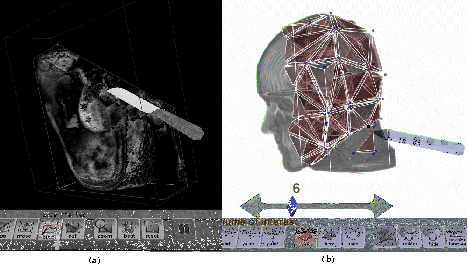
a useful function. Our tetrahedron editor (Figure
6b) combines the volume display tools above with other generic tools
such as point create/delete/move, and a few newly created tools specific
to the task.
Figure 6. (a) The cine-loop explorer. The oblique cutting plane follows the movements of the knife blade, slaved to the handle felt by the hand [14]. (b) The tetrahedron editor. Buttons control rotation (with and without scaling), free 6DOF motion, and the volume of interest; adding, deleting, moving vertices; adding a tetrahedron by selecting four vertices, undoing the most recent, or deleting a selected one; toggling the Z-buffer or the rendering mode to see tetrahedral surface vs. depth, skin vs. skull; toggle volume display; and read/write functions. The slider controls the trade-off between rendering speed and volume display quality.
This is the first Virtual Workbench application to be used for whole-day work sessions. There has been no experience of eyestrain or headache; elbow-on-the-table support proved sufficient for millimetric discriminatory precision (selecting between nearby points); the application does not depend on accuracy of absolute apparent precision (which indeed shifts when motions of an untracked head are possible), as long as the displayed tool remains close enough to the felt but unseen stylus for the user to accept that they coincide. Physical layout is important; an arrangement that had seemed satisfactory with short experiments produced neck strain in a tall user, until minor adjustments were made.
[Next] [Previous] [Up] [Top] [Contents] [Index]
Generated with Harlequin WebMaker