
(Swedish title: I Vildmarken)
There is a common conception that creativity is something that is connected to certain professions such as inventors, authors and artists. In contrast, in this research we stress everyday creativity, which is an ability that every person possesses (Waterworth 2001). For example we are often creative when we remember, work out how to do things, test ideas and learn different things in order to become better educated and to cope with life's problems. A creative action is one that is adaptive, novel to the person concerned, and that persists over time. In other words, it is something useful and new to the originator that is learned so that it can be used again.
Certain sorts of thing are easier to learn and remember than others. Emotion has been shown to be an important part of both creativity and learning, not least because emotions make us more engaged with the thing to be remembered. Some kinds of emotional arousal may also enhance the likelihood that novel solutions will be perceived. Perceptually Seductive Technology (PST) is a particular approach to the design of virtual environments that engage multiple senses and stimulate emotions to serve as powerful aids to everyday creativity for different groups of people (Waterworth, 2001).
The environment constitutes an important factor in people's lives. Some places are found inviting and appealing, some are found to be dull and boring, others seem threatening and possibly dangerous. Questions that deal with why people prefer certain types of natural environments, and how this can knowledge can be used to design virtual environments that elicit chosen types of responses, are a key element of this research.
The aim of the project is to investigate the use of Perceptually Seductive Technology (PST) as sensory stimulation and to motivate and support interaction, learning and recovery for people of various ages and abilities. One main goal is to use new technology to motivate people to learn actively in a rehabilitative and educational setting. The techniques could be applied in general education as well as to help people with some kind of handicap to rehabilitate and to train certain skills.
This project consists of several components, each with a different but related aim, and which are being implemented step by step. Currently our main focus is on the rehabilitation of users with brain damage. This component is a sub-project we call A Trip down Memory Lane. The actual research program consists of five related parts.
The phases of the project, and the
general approach taken, are based on the idea that the able-bodied and the disabled,
the retarded and the normal children, all share the ability to learn and to
improve their own lives. Similarly, education and rehabilitation can benefit
from new information technology, such as virtual reality, which can be used
to support physiological awareness, physical training and intellectual engagement.
- through the stimulation of the senses, integrated in environments designed
for specific educational and therapeutic purposes.
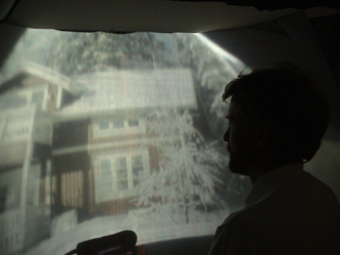
The aim of the project is to use Perceptually Seductive Technology (PST) as sensory stimulation and to motivate and support recovery after brain damage. One main goal is to use new technology to motivate people to learn and to train their memory in a rehabilitation setting. It could also include physical training, as the patient interacts with the system in order to control the experience.
The set-up consists of projecting a VR environment onto a 180 degree curved display screen that fills almost all of the user's view. The assistant or therapist selects and show pictures, films, sounds or a mix of these different media for the patient - according to the patient's condition. The pictures, films and sounds are usually familiar to the patient. They show the family, home, familiar places and so forth.
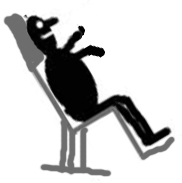
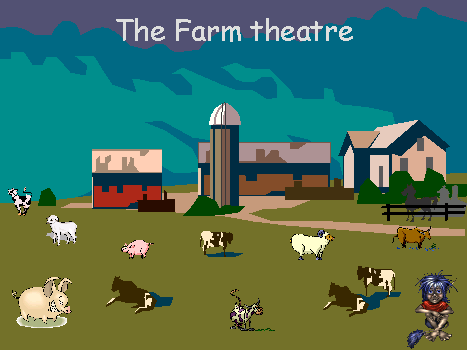
The purpose of the first part of the project is to design a prototype, which we call Gone to the Wild, according to the sketch outlined above and to test the prototype in a real setting. The experiment will be conducted in collaboration with a class of mentally retarded pupils at Berghems skola in Umeå, Sweden. In this, the aim of the application is to train the pupils in self-perception. The motive to choose this particular target group is the difficulty of the task. If we succeed to improve the learning of self-perception in the target group we believe that the approach is suitable to be used to engage and learn for people in general education. The result of this first phase is to develop guidelines for the design of creative learning environments for those with special needs. Preliminary visits and small experiments have already been made at the school.
The second part of the project will aim to test and apply the guidelines for design and technology developed in Part One in a general educational setting. The intention is to use an appropriately designed prototype during a specific class in an ordinary fourth year class (the pupils are between ten and eleven years). The result of the second part will be to provide guidelines and insight into the most effective ways to use information technology, particularly PST, to motivate pupils and to improve everyday creativity in normal educational settings. We will thus be testing the generality of the findings from Part One, and making specific adjustments as necessary.
The experiment in this part will be conducted in collaboration with a day-centre in Mörbylånga, Sweden, for severely handicapped people. This phase will run in parallel with Part One. With this third prototype the aim is to stimulate the user with a relatively simple VR set-up. The set-up will consist of projecting a VR environment onto a 180 degrees curved screen that fills most of the user's view. The user will interact with the environment via paddles that are controlled by hands, feet or head movements, depending on the user's ability. The prototype will be evaluated and an experiment will be conducted to collect both qualitative and quantitative data from the users (the severely handicapped people) and different staff at the day-centre. An extended preparatory visit has already been made to the day-care centre. Data from the experiment will be analysed statistically and used as input to Part Four.
In the fourth part the prototype will be further developed to include different kinds of sensors to control the VR environment. This phase runs in parallel with Part Two. The new prototype will be evaluated in an experiment conducted both at the day-centre in Mörbylånga and at Norrlands Universitets Sjukhus (the hospital) in Umeå, Sweden. In this fourth prototype the aim is to allow control of the application both via direct user input - such as the paddle - and via sensor control from different physiological functions of the user - such as heart beat, skin resistance and blood pressure. The aim of the fourth part is to gain knowledge about using physiological measures to control interactive environment and how this could be used in a rehabilitation situation.
The set-up will consist of projecting a VR environment on a 180 degrees curved screen that fills most of the users view (as used in earlier parts) and different kinds of sensors to monitor the user's bodily function and status. The output from the sensors is also used to control what happens in the environment. This suggests that the user interacts with the environment both consciously, via the paddles, and unconsciously, via the sensors. For example, the environment might become more tranquil, the river more slow-moving, as the user becomes calmer - effectively creating a biofeedback system. The prototype will be evaluated and an experiment will be conducted to collect both qualitative and quantitative data from the users (the severely handicapped people) and different staff at the day-centre and hospital. Data from the experiment will be analysed statistically and used as input to the fifth and final part. Furthermore knowledge will be gained of how to use sensors in rehabilitation and also to give some suggestions of how sensors can assist in controlling a virtual environment in rehabilitation, and perhaps in general education. The output of this part will be used as input to the fifth and final part.
The fifth part will develop the Gone to the Wild series of prototypes further to incorporate physical activity training by the user. The aim of this part is to use the prototype for sensory stimulation at the same time as physiotherapy, where the user trains different bodily functions. For example tactile feedback could be used in the paddle in order to simulate different kinds of obstacles, and other interaction devices could be used to complement the paddle in order to train several parts of the body. In this part the set-up from Part Four is expanded with several kinds of simultaneously working interaction devices, including tactile feedback. The prototype will again be evaluated and an experiment will be conducted to collect both qualitative and quantitative data from the users (the severe handicapped people) and different staff at the day-centre and hospital. Data from the experiment will be analysed statistically. The result of this part and the project as a whole will be knowledge of how new information technology, especially PST, can be used to support everyday creativity and learning in education and rehabilitation.
Attree, E. A., Brooks, B. M., Rose, F. D., Andrews, T. K., Leadbetter, A. G., and Clifford, B. R. (1996). Memory processes and virtual environments: I can't remember what was there, but I can remember how I got there. Implications for people with disabilities. In Sharkey P. (ed.), Proceedings of the First European Conference on Disability, Virtual Reality and Associated Technology, Maidenhead, UK, pp. 117-121.
Balling, J. D. and Falk, J. H. (1982). Development of Visual Preference for Natural Environments. Environment and Behavior, 14 (1) 5-28.
Brooks, B. M., McNeil, J. E., Rose, F. D., Greenwood, R. J., Attree, L. A. and Leadbetter, A. G. (1999). Route learning in a case of amnesia: A preliminary investigation into the efficacy of training in a virtual environment. Neuropsychological Rehabilitation, 9 (1), 63-76.
Carlin A. S., Hoffman H. G. and Weghorst S. (1997). Virtual reality and tactile augmentation in the treatment of spider phobia: A case study. Behaviour Research and Therapy, 35, page 153-158.
Dinh, H. G., Walker, N., Hodges, L. F., Song, C., and Kobayashi, A. (1999). Evaluating the importance of multisensory input on memory and the sense of presence in virtual environment. In L. Rosenblum, P. Astheimer, & D. Teichmann (eds.). Proceedings of the IEEE Virtual Reality '99 Conference (pp. 222 - 228). IEEE Computer Society Press: Los Alamitos, CA.
Fällman, D., Backman, A. and Holmlund, K. (1999) VR in Education: An Introduction to Multisensory Constructivist Learning Environments. Universitetspedagogisk konferens, Umeå universitet, 18-19 februari 1999.
Grealy, M. A., Johnson, D. A., and Rushton, S. K. (1999). Improving cognitive function after brain injury: The use of exercise and virtual reality. Archives of Physical Medicine and Rehabilitation, 80, 661-667.
Hoffman H. G., Hollander A., Schroder K., Scott R. and Furness T. (in press). Physically touching, and tasting virtual objects enhances the realism of virtual experiences. Virtual Reality: Research Development and Application.
McComas, J. (1998) Current uses of VR for children with disabilities. In G. Riva, B.K. Wiederhold, E. Molinari, Virtual Environments in Clinical Psychology and Neuroscience: Methods and Techniques in Advanced Patient-Therapist Interaction (pp. 161-169). Amsterdam, The Netherlands: IOS Press.
Orians, G. H. and Heerwagen, J. H. (1992). Evoked responses to landscapes. In Barkow, Cosmides and Tooby (eds.), The Adapted Mind: Evolutionary Psychology and the Generation of Culture. New York: Oxford University Press.
Papert S. (1980). Mindstorms: Children, Computers and Powerful Ideas. Basic Books Inc., New York NY.
Rizzo, A. (2000) A VR Applications for the Assessment and Rehabilitation of Attention and Visuospatioal Cognitive Processes: An Update Proceedings of the 3rd International Conference on disability, virtual reality and associated technologies, Sardinia, Italy, September 2000
Rose, F. D., Brooks, B. M., Attree, L. A., Parslow, D. M., Leadbetter, A. G., McNeil, J. E., Jayawardena, S., Greenwood, R. J., and Potter, J. (2000). A preliminary investigation into the use of virtual environments in memory retraining of stroke patients: Indications for future strategy? Disability and Rehabilitation, 21 (12), 548-554.
Strickland D., Hodges L., North M. and Weghorst S. (1997). Overcoming phobias by virtual exposure. Communications of the ACM, 40 (8), 34-39.
Waterworth, E. L (2001). Perceptually-Seductive Technology - designing computer support for everyday creativity. Report RR-01.01 (Doctoral Thesis) ISBN 91-7305-117-9. Umeå University, Department of Informatics.
Waterworth, J. A. (1998). Survey of Medical Applications of Virtual Reality. Web version: July 1998. Print version: Dept of Informatics Research Report #9802, October 1998.
Wells M. (1997). Virtual Pilot 3: Use of a Virtual Pilot to Aid Communication in a Mulit-Crew Environment. (Technical Report R-97-49). Seattle: Human Interface Technology Laboratory.
Wells M. and Hoffman H. (1998). Using the Virtual Pilot (ViP) to Enhance Multi-Crew Performance in Complex Military Environment. (Final Progress Report R-98-17). Seattle: Human Interface Technology Laboratory.
Youngblut C. (1998). Educational Uses
of Virtual Reality Technology. Institute for Defense Analyses, IDA Document
D-2128.
Last updated: April 21, 2002
© Eva Lindh Waterworth, 2002,
all rights reserved